Concrete Demolition in Cape Town: Slabs, Footings, Driveways, Paving and Retaining Walls
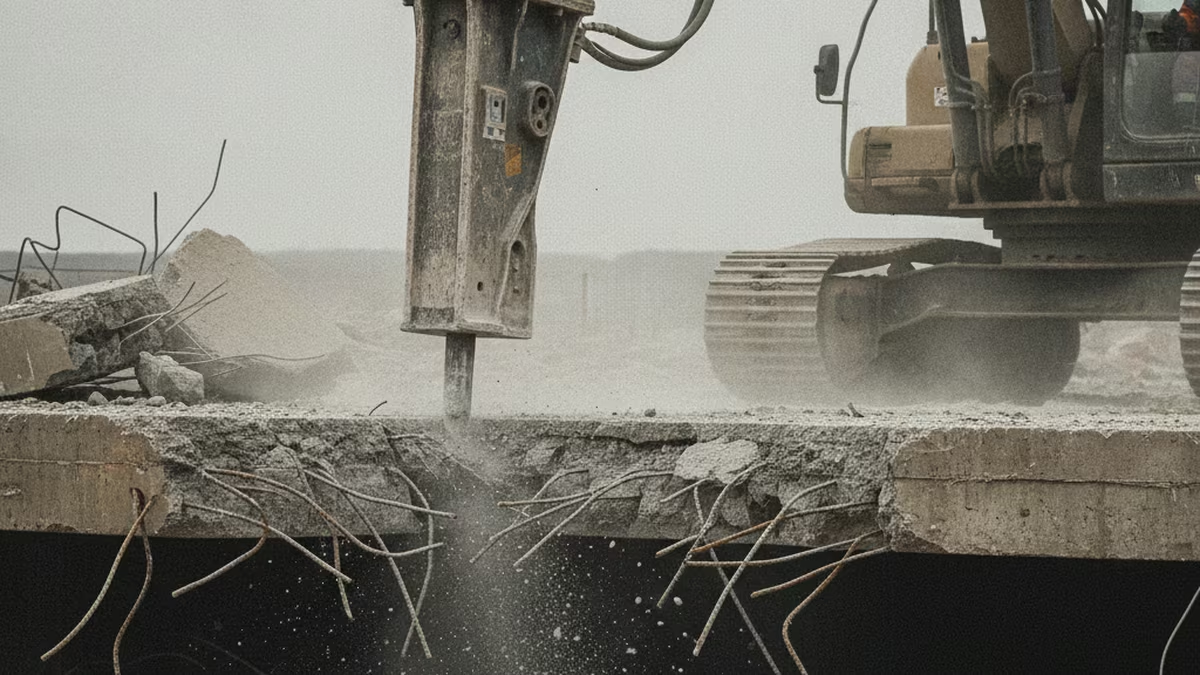
Reinforced concrete needs two tools rather than one. A hydraulic breaker fractures the concrete, and a shear cuts the reinforcing bar that holds the fragments together. Concrete demolition prices by thickness and reinforcement density rather than by area alone, because a 300 mm reinforced slab carries roughly three times the breaking work of a 100 mm unreinforced one.
Free site visit and written quote anywhere in greater Cape Town.
Concrete elements and what each takes
| Element | Typical thickness | Tool | Reuse |
|---|---|---|---|
| Domestic floor slab | 85–125 mm | Breaker | Crushed for fill |
| Suspended slab | 150–250 mm | Breaker plus shear, propped below | Crushed; bar to scrap |
| Strip footing | 200–400 mm | Breaker, excavated out | Crushed for fill |
| Foundation and footings | Varies | Excavate then break | Crushed for fill |
| Driveway and hardstand | 100–200 mm | Breaker, saw-cut edges | Crushed on site |
| Brick and block paving | 50–80 mm | Lifted, not broken | Pavers relaid or resold |
| Retaining wall | 200 mm plus | Sequenced top-down, ground retained first | Crushed |
| Kerb and channel | — | Lifted or broken | Crushed |
Retaining walls hold ground, so sequence matters
A retaining wall carries the soil behind it. Removing it without addressing that soil causes the bank to slump into the excavation, and the failure takes the ground beside it. A retaining wall demolition therefore starts with the retained material: the bank is cut back or battered to a stable angle, or a replacement retention is installed, before the wall comes down. Demolition runs top-down in courses rather than by pushing the wall over.
Crushing on site
Broken concrete crushes into a granular fill that substitutes for imported material. Crushing on site removes two costs at once: the disposal tonnage that would have gone to landfill, and the fill that would have been bought in. The trade-off is space and noise, since a crusher needs a working area and runs loud. On a constrained suburban site the material goes to a licensed landfill instead.
Spalling concrete on the Cape Town coast
Salt-laden air on the Atlantic Seaboard, False Bay and Blouberg drives chloride into concrete and corrodes the reinforcing bar inside it. Corroded bar expands, and the expansion cracks the concrete off in sheets. That failure mode, called spalling, is the reason many coastal balconies, walkways and structural frames reach demolition long before an inland equivalent. Spalled concrete is structurally unsound at the corroded bar, and it is assessed before any load is placed on it during demolition.
Frequently asked questions
How much concrete can be broken out in a day?
A 20-tonne excavator with a hydraulic breaker takes out roughly 80 to 150 square metres of 100 mm unreinforced slab a day, including load-out. Heavy reinforcement halves that, because the bar has to be sheared and separated rather than simply broken through. Access and stockpile space set the real limit on a suburban site.
Can broken concrete be reused on site?
Yes. Broken concrete crushes into a granular fill that replaces imported G5 material for backfill, platforms and sub-base. Crushing on site removes both the disposal tonnage and the imported fill cost. The constraint is working space and noise, so tight suburban sites usually dispose instead.
Do you remove foundations as well as the slab?
Yes, where the scope calls for it. Demolition to footings excavates and breaks out the foundations and footings, leaving clean soil. A rebuild on a new footprint needs that, because old foundations obstruct new ones. See house demolition.
Is paving broken up or lifted?
Brick and block paving is lifted rather than broken, because intact pavers carry resale value and relaying them is cheaper for the owner than buying new. Cast concrete and tarmac surfaces are broken out. Lifting is slower per square metre than breaking and is priced accordingly.
Why is coastal concrete in worse condition?
Salt-laden air drives chloride into concrete and corrodes the reinforcing bar inside. Corroding bar expands and cracks the surrounding concrete off in sheets, a failure called spalling. Balconies, walkways and exposed frames on the Atlantic Seaboard and False Bay coast reach that state decades earlier than inland equivalents.