Swimming Pool Demolition in Cape Town: Full Removal and Partial Removal with Fill-In
Two options exist for an unwanted pool, and they differ in cost and in what the ground can carry afterwards. Full removal takes the entire shell out and leaves compacted soil that can be built on. Partial removal breaks the top of the shell down, perforates the base and fills the void, which costs less and leaves ground suitable for lawn and planting but not for a structure.
Free site visit and written quote anywhere in greater Cape Town.
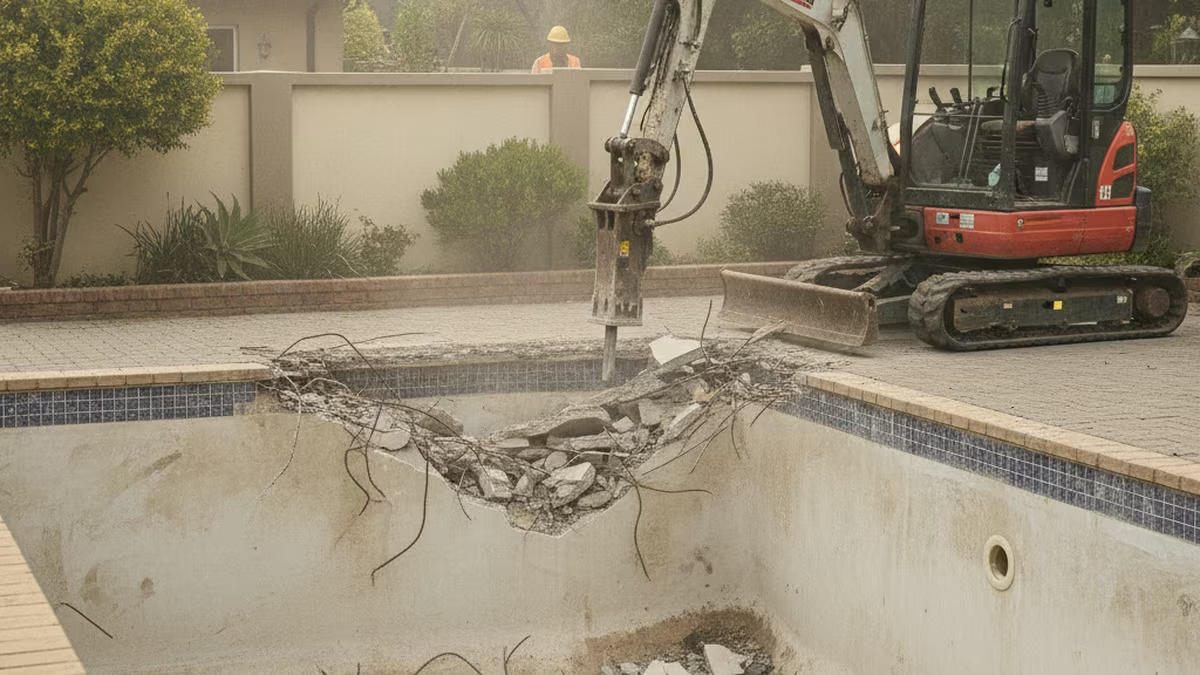
Full removal against partial removal
| Full removal | Partial removal and fill-in | |
|---|---|---|
| Shell | Entirely removed | Top 600–900 mm broken down, base perforated |
| Material off site | All of it | Roughly a third |
| Fill required | Full void, engineered layers | Full void, engineered layers |
| Cost | Higher | Lower |
| Build on it afterwards | Yes, subject to compaction testing | No |
| Declarable on sale | Normally no | Yes — disclose the filled void |
Partial removal must be disclosed when the property is sold. A filled pool void is a material fact about the ground, and a buyer intending to build over it needs to know.
Why the base is perforated
An intact pool base holds water like the pool it used to be. Rain moving through the fill collects on that base, saturates the fill from below and causes the surface to sink and stay wet. Perforating the base lets water drain into the ground beneath instead. The perforations are cut through the shell floor across the full area rather than in one or two places.
Sequence
- Drain and disconnect. Water pumped out to a legal discharge point, pump, filter and electrical supply isolated and removed.
- Strip fittings. Lights, skimmers, weirs and pipework removed.
- Break the shell. Full removal takes it all out; partial removal takes the top 600 to 900 mm and perforates the base.
- Separate reinforcement. Bar sheared out of the broken concrete and sent to scrap.
- Fill in layers. Clean granular fill placed in 200 to 300 mm layers, each compacted before the next.
- Top and reinstate. Topsoil to the surface, paving made good at the edges.
Compaction in layers is what stops the surface settling later. Filling a void in one lift produces ground that sinks over the following two winters, and Cape Town's winter rainfall accelerates it.
Access is the main cost driver
Most Cape Town pools sit in back gardens behind a house, with access through a side passage or a gate. A machine that cannot reach the pool changes the job entirely: material is barrowed out by hand, and fill is barrowed in. Access is measured at the site visit, because the difference between machine access and hand access is the single largest variable in a pool removal quote.
Frequently asked questions
How much does it cost to remove a swimming pool in Cape Town?
Pool removal is priced on shell size, removal method and access, with access the largest variable. A pool reachable by a compact excavator costs materially less than an identical pool behind a narrow side passage where material is barrowed by hand. Full removal costs more than partial removal and fill-in. See the estimator on demolition costs.
Can I build over a filled-in swimming pool?
No, not over a partial removal. A partially removed pool leaves a filled void that is not certified to carry structural load, and it must be disclosed on sale. Full removal with layered compaction and testing produces ground that can carry a structure, subject to an engineer's assessment of the compaction results.
How long does pool removal take?
A partial removal and fill-in on a pool with machine access runs 2 to 3 days. A full removal runs 4 to 6 days. Hand access adds several days to either, because both the broken shell and the incoming fill move by barrow rather than by machine.
Will the filled area sink later?
No, where it is compacted in layers. Fill placed in 200 to 300 mm layers and compacted between each layer does not settle materially. Fill dumped in a single lift does settle, and Cape Town's winter rainfall accelerates it over the first two seasons. Layered compaction is the difference, and it is not visible once the topsoil is on.
What happens to the pool water?
Water is pumped to a legal discharge point rather than released across the property or into a stormwater drain untreated. Chlorinated water needs its chlorine level dropped before discharge. The discharge route is established before the pump starts.